

Technical Description of ESD
ESD is widely misunderstood. Myths exist. The following treatment is an explanation of what ESD is at reasonably high technical level. All engineers should have understanding to this level or above. Operations experts should have understanding at this level – in operations the status quo is more compliance than understanding, but this has led to imperfect implementations of ESD protection even in technically advanced companies. Individuals involved in Quality Assurance should have understanding too – particularly because they are often tasked with finding root causes.
ESD Explanation
There are two vessels for the charge that result in a damaging discharge: the human and the atmosphere. The latter is very important, but usually overlooked.
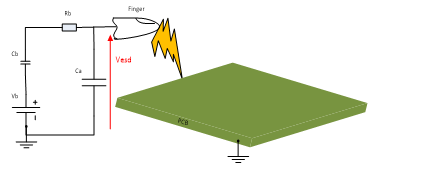
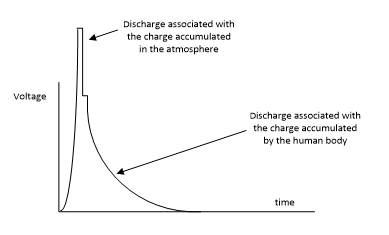
Human beings build up charge through friction between them and their clothes, i.e., via the triboelectric effect. This is mitigated in industrial environments by: making people in the environment wear clothes that are least likely to generate charge; using wrist straps and footwear that dissipate charge when a suitable discharge path exists; providing the discharge path using dissipative mats, floors, furniture, etc.; and ensuring that sensitive components are transported and stored in dissipative bags and containers. The circuit in Fig 3.1 illustrates the charged human via Vb, Cb and Rb, which is a system with a relatively long time constant and lower peak voltage when compared to its atmospheric counterpart (Ca with a very low indeterminate value of Ra [resistance limiting discharge by the atmosphere]).
The atmosphere becomes charged, and it is through this that the most damaging ESD occurs, and it is this that is commonly misunderstood. The circuit of Fig 3.1 illustrates this via Ca and Vesd. Ca is the capacitance of the air between the conductor formed by blood flowing in the victim’s finger, and the insulating properties of the skin and air between this conductor and the conductor on the PCB that suffers the electrostatic discharge. The charge is equal to the Vesd x Ca. The resulting discharge has a high peak voltage and short time constant. Since the discharge is principally a function of the charge held in the atmosphere, no amount of ESD clothing, equipment or training for people will prevent it (the most effective way to reduce it is to introduce de-ionising machines in the workplace [note air conditioning units charge the atmosphere in a damaging way]). Charge tends to accumulate in the atmosphere when humidity is low (dry air), and by monitoring humidity it is possible to identify times at which the risk of damaging atmospheric discharge is present: handling of PCBAs should cease when this is the case. When humidity is high the atmosphere is less likely to hold significant charge, but the likelihood that discharge will occur is higher (wet air). This suggests that there should be both lower and higher trigger values of atmospheric humidity outside which no handling of PCBAs should occur.
Electronic chips were relatively susceptible to ESD decades ago, but modern chips usually quote a ‘body model voltage’ which is normally in the region of 2kV. Good designs also include protective measures outside the chips such as clamping diodes and transzorbs so that failure is much rarer than it used to be, but it would be remiss of a designer or manufacturer to not be seen to be taking to steps to reduce the effects of ESD.
KEY POINTS:
- Damage from ESD is insidious. It may destroy a component instantly and hence make known the fact that a PCBA is compromised, but it can also simply shorten the life of a component.
- The worst damage from ESD occurs via atmospheric not human discharge, and this is usually controlled by setting humidity limits outside of which no work should be carried out on PCBAs, and/or the introduction of de-ionising equipment .
- All reasonable steps should be taken to reduce the risk of discharges from humans (ESD reducing clothing and equipment, etc.)
- There are international standards for the control of damage from ESD – follow these (BS EN 61340-5-1:2016).
- Note that the addition of conformal coating can significantly improve the level of resistance to ESD. For the discharge to occur the conformal coat would need to physically break down under high voltage, and this is unlikely because conformal coats are designed to have high dielectric strength.