

Medical Devices, LED optical performance (general optics), and the Market
Non-invasive medical measurement and also treatment is becoming very topical in the world of medical device development. Treatment and measurement using optical techniques, i.e., LEDs and lasers, based on spectroscopy (spectral absorption) are now common.
Determining optical output power or energy densities for LEDs by test or calculation is often not well covered in datasheets. This article has been written to throw some light on the topic for those companies developing light based treatment or measurement for medical devices, regardless of whether it is infrared, ultraviolet (typically UVC), or any other section of the spectrum that is of interest.
Typical application examples are:
- Infrared LEDs and specific wavelength LEDs being used to facilitate accelerated healing of wounds.
- Absorption spectra for anaesthetic agents being used to detect agent delivery during operations (medical) – electronic vaporisers.
- UVC being used to disinfect or destroy infections
- Absorption spectra being used to detect blood sugar levels
If you have an interest in this topic, please don’t hesitate to contact us.
How to Calculate Optical Power and Energy Densities for LEDs
It is possible to calculate the optical output of an LED. The paper below shows the detail. Better than +/- 15% accuracy can be achieved with this method, but the mathematics is a little tedious. The EM recommends constructing a spreadsheet (software if you can find appropriate APP) if this method is to be used. Even if not to be used, it is worth studying the paper because it leads to a full understanding of what’s being measured.
Are there international and national standards that apply?
The short answer is yes, and these can be quite involved and complicated. The exact standards that will apply to a given medical device development will be device dependent, but some key ones are ISO 60825 and EN 60601. The former’s complexity may cause concern, but bear in mind that it is covers lasers and a deal of variation in application. It is not as daunting as it looks.
Please feel free to contact the EM if you need assistance.
How to measure the optical output of LEDs
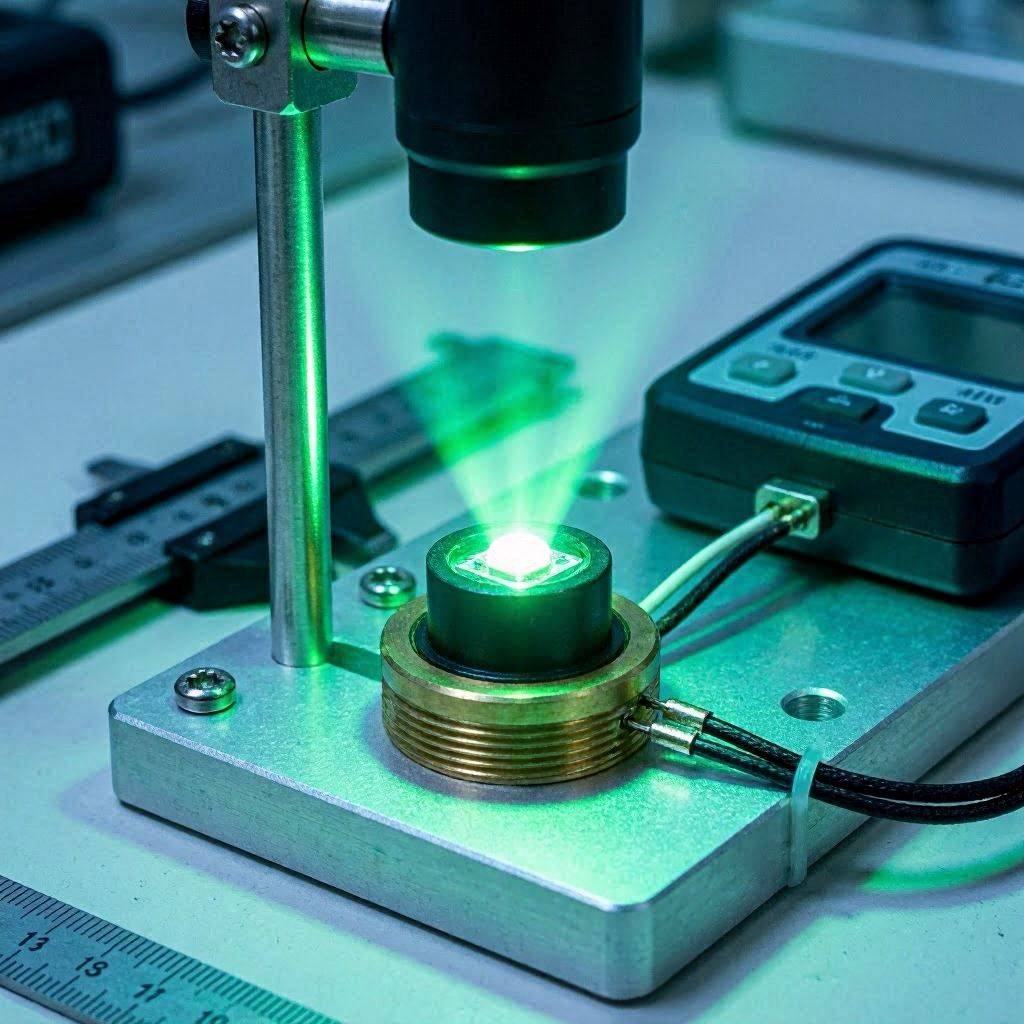
Clearly, optical output can be measured with expensive equipment from suppliers such as THORLABS, but there is much that can be determined with much cheaper equipment and application of the theory covered in the White Paper above.
There a few key measures that must be verified to confirm the performance of an optical system:
- Wavelength usually quoted in nm for LEDs
- Optical power density usually quoted in mW/cm2 for LEDs
- Optical energy density usually quoted in J/cm2 for LED systems. The energy density follows directly from the power density by simply multiplying treatment time.
Wavelength and energy density are usually the key drivers for a medical device based on optical treatments. Measurement of these can be achieved by:
- Wavelength (spectrometer). Usual cost about £1,500.
- Power density can be measured by either a light meter or a spectrometer. Energy density follows by multiplying power density by time. Light meters (make sure they are valid for the wavelength’s of interest) can be obtained for about £300 to £500.
The measurement techniques above average over an area (diameter around 10mm). It is not point measurement. If a beam profile is required, it is likely bespoke equipment will be needed – contact THORLABS – the cost of this will be in the region of £7,000 to £10,000.
Where do I go to get the right light source (LED/Laser)
An oft occurring mistake is to use the grey market or smaller fast turn distributors like Digikey, Farnell, etc.
We recommend that you make contact with substantial distributors from the off when developing a medical device. The advantages are as follows:
- More often than not samples come free
- Your clients can be hooked up with such distributors and logistics then become someone else’s problem when the medical device is being manufactured and sold in volume.
- You have access to specialist FAEs (field application engineers).
- Your client will be impressed because dealings become professional – confidence building.
- Continuity of supply is more assured than with other sources.
An example of such a distributor is EBV. There are a multitude of others.
Please feel free to contact us if you have any questions or would like help with a medical device development.