

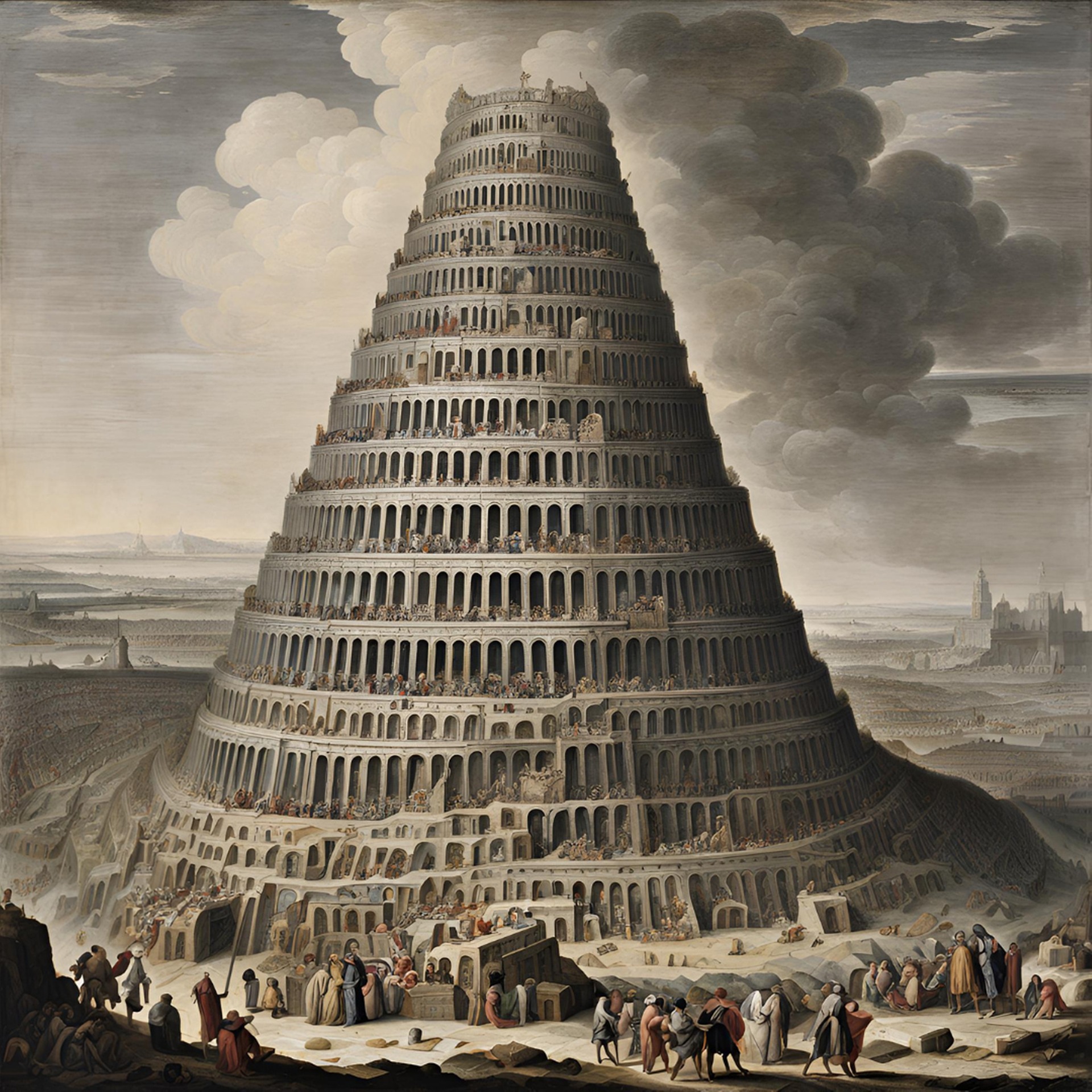
As the Corporates ascend the Tower of Babel with Cloud AI, is there an opportunity for Tech-SMEs to confound them with Edge AI?
The harsh reality regarding uptake of AI in physical products is somewhat stark from the viewpoint of Tech-SMEs. Only 11% (UK) of Tech-SMEs have integrated AI into the technical products they sell (ref: Thames Valley Chamber of Commerce), but this may turn out in their favour .
Larger companies and the supply chain for AI are encouraging, where practicable, solutions through Cloud AI. It is difficult to substantiate this assertion because the commercial entities involved are not forthcoming with data. The following is offered as circumstantial evidence:
- A substantial marketing company, Future Business Insights, Edge AI sits at 14% of all AI development. It should be more like 70%.
- London Tech Week 2026 was dominated by companies offering predominantly Cloud AI services.
- The explosion in requirements for data and computational resource manifesting itself in enormous energy guzzling data centres. Problems with these range from overheating, water polluting, fossil energy guzzling to plans to put such centres on the Moon. For those with the stamina, the following articles cover the ills involved (Bee harming, Moon based data centre/s, Pollution in Texas, Guardian Critique of Data Centres, Noise, Energy Demands, US Federal Bill to halt Data Centre building, New Your 1 year pause on Data Centre construction). If AI were being implemented on a balance Edge AI/Cloud AI model, these Data Centres would not be required.
Cloud AI has a tantalising advantage in that Edge technical products need only implement straightforward communications (BLE, WiFi, Ethernet) to invoke the vast resources of the web, but this could be a poison chalice that Tech-SMEs may have been wise not to follow too hastily. Central Cloud-AI control of dumb Edge devices is a vulnerable model that may be the next bubble to burst.
The burgeoning model described above has already been well documented, but what seems less well known is that for AI to properly succeed there is no dodging the modelling and work necessary at the Edge. In other words, balanced Edge and Cloud AI provides the answer to the issue in the previous paragraph.
A planned and structured approach that manages the balance between Edge and Cloud AI is a roadmap that Tech-SMEs should follow.
Edge AI modelling and product development is an EM core skill. Please feel free to Contact Us if you have such needs.
The Tower of Babel: the Holy Grail of ubiquitous and powerful Cloud AI
There’s a fast evolving model of AI that bears a disturbing resemblance to the parable of the Tower of Babel. The Genesis (11: 1-9) parable relays the vainglorious attempts of man to become all knowing by building a tower that would have reached Heaven, thereby opening the door to all knowledge. The attempt was foiled by God, who distributed mankind over the Earth and introduced different languages in all the areas of distribution. The Tower failed thereafter because the people were confounded through not being able to communicate.
The analogy with the evolution of AIaaS, or Cloud-Native AI, makes the Tower of Babel analogous with Cloud AI. Heaven analogous with the aspiration to answer all via one ubiquitous, all powerful, Cloud, and languages synonymous with Edge AI that is autonomous after the intervention of the divine in the case of the parable and common sense in the case of the evolution of AI.
It’s evident that a world of Cloud AI where all data and corresponding computational resource are embodied in the Cloud with dumb Edge devices is a goal that’s akin to the pot of gold at the end of the rainbow. The data model under this definition is effectively infinite, as is the corresponding AI computational requirement. This is manifesting itself in data centres like Slough’s in England and Texas that are fast morphing into unmanageable leviathans. The enormity of this model that the whole of Jupiter could be covered in a planet-wide data centre, but would still be outgrown. This Cloud dominant model demands an infinite resource because the data and computational requirements are infinite. It is unsustainable and balanced Cloud AI:Edge AI ratios must be established to make the model finite and achievable.
The vulnerability of a dominant Cloud, dumb Edge model
There is no escape from the following:
- Dumb Edge devices are totally dependent on the Cloud en masse. A Cloud fault results in global failure. An Edge AI failure is local and contained.
- The previous bullet highlights the vulnerability of a Cloud dominant model to hacking. Naturally, it will be countered that the Big Data Centres are firewall protected and meet demanding international standards that give confidence of security, but such protection obeys a law of diminishing returns against cost and catastrophe if it fails. Consider the power of the demons (Russia, China) that might assail AI models running and built predominantly in the Cloud. Edge AI models are far more difficult to hack, and the consequences of hacking are likely to be contained locally. In fact, thoroughly distributed Edge AI will predominantly only need to talk to the Cloud and rarely listen. This shuts the door even more thoroughly on hacking.
- Latency, i.e., delay in response from device to Cloud and vice versa, is usually an understood drawback. Imagine the global chaos if the current model overloads. Edge AI dominant solutions remove this predicament because the power necessary for the AI is local, predictable, and consistent between operations. For example, imagine a traffic light on Old Kent Road, London waiting for a super computer in Wyoming to give permission for it to turn red. Edge AI would allow the traffic light to turn red based on the data it receives directly from local sensors.
Human attitudes to AI
The direction of AI development being biased towards central control in the Cloud (ref: ratio of solutions in Cloud vs. Edge) fits with the idea of a path of least resistance because it is easier to implement than Edge implementations. But if this is the preferred path for most of the data storage and computations, AI hardware resource needs to become effectively infinite.
Being speculative, it’s hard to avoid the conclusion that human endeavours leading to an all knowing Cloud smack of arrogant ambition. Likewise, avoiding the depth of analysis needed to implement solutions in Edge AI hardware smacks of intellectual laziness.
The penchant business has for choosing what’s quickest and easiest in the short term because decisions can be justified by objective facts and ignoring speculative predictions. There always exists a significant probability of error, is both the secret to successfully controlling the immediacy cash flow in the case of the former and the reason for long term decline in the latter.
Human parallels are worthy of comparison with the distribution of AI power. A bugbear for many people is being micro-managed in the workplace. Cloud AI can of course do the same. Micro-manged soft infrastructure results in dumb edge devices that breaks at the first sign of a crack in the Cloud. Very much as micro-managed employees follow instructions exactly, but when the instructions don’t fit the environment they take no action.
The pernicious product that numerous software companies purvey promising seamless entry into twenty first century AI via software platforms could lead to a catastrophe if Tech SMEs are persuaded by the vapid and sensational marketing of such enterprises. This article recommends Tech SMEs consider the tenets for Edge AI implementation listed later in this document.
What is the right balance between Cloud AI and Edge AI?
Humankind is on the cusp of coming to terms with the enormity of an AI world. It would be supreme arrogance for an article such as this to dogmatically state a solution as if it were an obvious and sole answer to the issue, but answers do lie in history.
The human creation of an omnipotent computer brain that delivers efficiencies yet unheard of buckling under the strain of its own vastness, which is comprised of predominantly redundant data, is a situational irony of note. It could be argued that human ingenuity is already crossing the technological bridge that provides the answer in the form of Quantum computers. These operate at very low temperatures and have orders of magnitude more power than existing computers. However, this quixotic argument would still be flawed because it fails to recognise that a central all powerful Cloud is an infinity that no mortal’s invention can control. If quantum computing did become mainstream, it would only kick the can down the road.
The balance of power between a nation-state and its corresponding federal authority, just like the balance between Cloud AI and Edge AI, has been and is a bone of contention. The US’s founding fathers provided an answer that is paradoxically elegant, yet flawed. It is via this principle that a balance between Edge and Cloud AI may be found.
The next two paragraphs may be skipped by those conversant with the principle of the 10th Amendment. For those who are not, it’s important to understand its foundations. Consider the problem of the representation of nation-states at federal level. If each state is given equal representation, the state of Texas is afforded the same representation as Rhode Island, which has a thirtieth of the population giving RI disproportionate power. If the representation were proportional to population, Rhode Island would have no effective voice (1 member in the House of Representatives to Texas’s 30).
How can every nation-state hold and control its local destiny under such circumstances? The 10th Amendment provides that all power rests with the nation-state except in respect of those powers defined as federal in the constitution and those for which it is reasonable to deem them federal. The arbitrator of this law is the Supreme Court: it can defy Congress. This law has existed for almost as long as the US and is undoubtedly the glue that holds the states together. It also protects the striking anomalies that other nations find difficult to accept (death penalty in some states and not others). The nuances of this law are not the topic of this article, but the principle is. It finds application in a model that could define a meaningful balance between Edge and Cloud AI.
The 10th Amendment protected the local rights and desires of people from varying religions, customs and ethnic origins in such a manner that overarching law could empower a federal government, but said government could not trespass on the rights of the varying communities. It protected the individual rights of like minded groups.
This raises the question of how the 10th Amendment principle could provide a paradigm for establishing an optimum balance between Edge and Cloud AI.
The following are tenets that the author believes justify such a model:
- Many may assume that the answer to the ratio of Edge:Cloud AI lies in technological performance, e.g., minimised latency. The real requirements are human. AI power should be situated where it brings the highest added value to humans. That’s why a human rule rather than a mathematical model should determine the Edge:Cloud ratio for AI.
- Edge devices should be able to operate autonomously at the Edge. What human wants a device that is useless because its connection with the Cloud is down?
- Edge data should, wherever possible, be Edge processed. What human wants the unpredictability of Cloud latency?
- Edge devices should be able to talk to the Cloud by choice, probably from a human’s direction. What human wants Cloud interference when the Edge has all it needs to perform its task?
- The Cloud, released from the tedium and resource requirement of computing and storing what’s local, can be directed at greater things.
- Implementation of the above principles would be best addressed via international standards similar in operation to the CE Mark. Statements of conformance rather than precise figures are more meaningful and realisable. CE marking is very much about compliance in spirit and that’s what’s needed for management of the Cloud:Edge ratio.
Tech SMEs must grasp the nettle and implement AI at Edge with their devices. It will hi-jack power from corporate monopolies and deliver a sustainable AI future. The alternative, dominant Cloud AI at the cost Edge, will usher failure followed by expensive disruptive resets.
What’s the right way to treat AI? Cloud, Edge, and all
Current affairs are rife with inflammatory reporting inciting fear that it is the middle class’s turn to suffer large scale job losses because of technological advance. That AI ushers in an era of profound change is beyond question, but it should raise human expectations rather than deflating them. History has some lessons that suggest the technological advance has and always should lead to a raising of the bar for human endeavour. In almost all cases advances have, in the long term, benefitted all concerned. Technological advance removes tedium and drudgery from humanity thereby forcing it to innovate and advance. Some examples follow terminating in AI and the author’s thoughts on how it might be considered:
- the tedium of arithmetic calculation was for centuries done using log tables. Real drudgery that took hours (sailors particularly).
- The slide rule, although invented in era of sail, took its practical form in the middle of the 19th century. It could have been thought that its invention would have sped up calculations so much that those doing them with log tables at the time would have lost their jobs. What really happened was jobs advanced to make more people able to make use of it.
- Calculators effectively did to slide rules what they’d done to log tables. The same effect. Simple arithmetic calculations became trivial and weren’t a barrier. This forced up exam and industrial standards.
- Programmable calculators ushered in an era of paranoia that students could program them to solve problems. What happened was problems became more demanding and ambitious, meaning having a programmable calculator did no more than add a tool for convenient calculation.
- In effect, AI puts the sum of human knowledge at the fingertips of the user. It is a profound advance, but the message is clear. Humanity must apply itself to what’s new or undiscovered, using AI as a tool to assist in the solution of problems. Schools, universities, industry, and all must apply this.
What’s the recommended Edge AI route for Tech SMEs?
If the arguments above take hold, the question immediately begged is: What does a Tech SME need to do to implement Edge AI and what benefits will be reaped by doing so. Nothing that’s worth having comes at no cost. Tech SME’s will need to absorb greater development costs than would have been the case for non-AI products. The following points are offered as guidance:
- Every product will have differing needs, but AI at the Edge essentially means smarter analysis of the data from a product’s sensors.
- Most sensors will fall under the discipline of machine learning, which covers sensors such as pressure, temperature, humidity, etc. Development usually takes the base requirement that a product works in its desired environment. This manifests itself in a development cycle that is design, build, test, and iterate until the specification requirements have been met. It is often not a holistic solution because it may not be possible to state that the transfer function for the device is known, i.e., it is mathematically modelled. Edge AI that is properly implemented may not allow a partial understanding. Machine learning is effectively a statement that the device is mathematically modelled using law fitting techniques. This requires greater rigour in early prototyping and testing than might have been the case formerly.
- Not all sensors are as straightforward to model as a pressure or temperature sensor. Consider data from a CCD camera. If it is assumed that a medical product is using the camera, it might be desired for an AI algorithm to recognise a pathology in part of an image. This might involve complex probabilistic and statistical calculations, iteration, neural nets, and other mathematical techniques. Furthermore by definition, the model will likely handle more data than is the case in the previous bullet. This has a knock on of a need for greater computational power and data storage, which has hardware implications that must be evaluated during Edge product designs.
- The testing and modelling described in the previous bullets should be regarded as extra budget over usual allowances
- The upside is that the birth of AI has also spawned numerous software packages that can assist with this. There are not just enhanced capabilities for products, but also analysis such that originally unknown capabilities that answer new problems are unearthed.
Contact us to learn more.