

Case Study: ECG Development for Stress Monitoring
Preventing serious work stress related conditions with wearable technology – ECG monitor.
Challenge: Stress related work issues are a debilitating and shocking medical (link to medical and pharma market sector page) issues for the victim, but they are also a source of risk for employers. A benevolent employer can miss the circumstances that lead to its employees suffering from stress related illnesses but not avoid the consequences. A means of monitoring stress at the start, during, and end of employment is required to address the root cause issue.
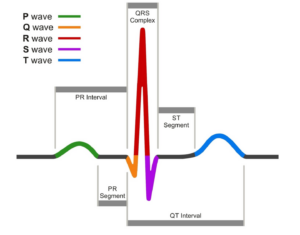
Solution: The Electronics Machine developed a miniature ECG machine that monitored the time between QRS complex peaks and statistically analysed them (see image below for ECG waveform definitions). These, via the algorithms that HSG used, allowed for the pre-detection of stress in an individual. This meant the stressful state of any individual at any stage of employment could be measured and necessary mitigating action taken. It also provided for reduction in employer insurance premiums.
Note that these stress issues link with cortisol levels in the blood and the Circadian system – See Circadian Lighting Article.
Skills: The skills required of the Electronics Machine were:
- Knowledge of MDD (Medical Device Directive – as it was at the time) and standards approvals for bringing medical devices to market. Note that the MDD has now become the MDR (Medical Device Regulations) and is significantly more demanding.
- EMC testing – planning and preparing. EMC testing is often over done and more costly than needed through lack of preparation (plan) and inadequate preventive measures during design. The EM prides itself on suffering neither of these failings.
- Advanced analogue electronics to deal with high signal to noise ratios (SNR) – particularly at 50Hz and 60Hz mains frequencies.
- DSP – digital filters. IIR filter implemented for device. Matched and optimum filter design implemented.
- FMEA (failure mode and effect analysis). A technique that has now become so embedded in advanced product design and manufacture that an absence of knowledge of it is unacceptable.
- Physiology of skin and conduction mechanisms in the human body. All projects require designers to profoundly understand the science underpinning the application. This project was no exception.
Journey: The essence of success for any medical device development is the team. It is essential to bring together and foster a progressive and dynamic team – this is true of any product development. The skills never all lie in one place:
- There must be a clinical expert involved somewhere in a medical device development, e.g., a doctor, and that expert must passionately engage and own the project. HSG had this.
- There must be professional mechanical and electronic design skills in the team. The EM provided these.
- The team must be led by someone with commercial acumen and a clear vision of the goal. HSG had this.
- For medical devices, there must be a team member with a deep understanding of the regulatory requirements. This can be and was the engineering team for HSG, but this isn’t always so.
There are other elements to the kind of team necessary to bring new products to market, but the final key element that cannot be overlooked is time to market and the cost of delay. This is crucial to every project – see article on the Cost of Delay.
If you have any questions or wish to discuss this article, please don’t hesitate to contact us.