

Fast Tracking Patent Value of Medical Devices
This article is not to be construed as legal advice. Contact a patent attorney for such advice.
The journey from an idea to a valuable, patented, medical device is tortuous. This article maps the journey and its risks. The essence of the idea is always well within the clinician’s gift, but how to realise the product and generate monetary value are challenges medical professionals may be unfamiliar with. This article attempts to de-mystify this process.
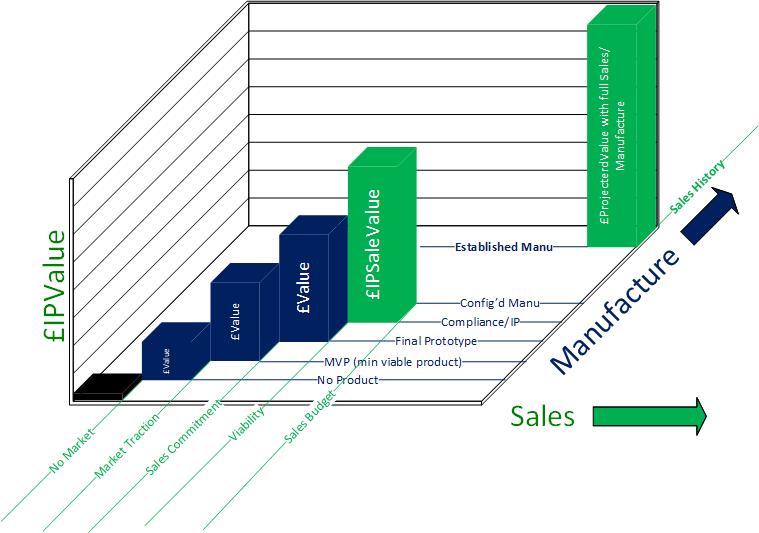
What determines the value of a patent?
Unless there is some fame associated with the inventor, like being an internationally recognised expert or being associated with a tier one university and funded, the value of a patent is determined solely by how close it is to manufacture in volume and viable sales. A patent at idea stage is usually valueless, as the image above shows at the black no product/no market stage.
The graph above illustrates how patent value grows as milestones are reached, culminating in a product being manufactured and sold (at which time the patent value is high if the project has shown itself to be viable and a good candidate for growth).
There are key coordinates in the image above. Each is explained in the bullets below:
- No Market, No Product: if the status is that there is no realisation of the medical device and the route to market is unestablished, the patent and idea have no effective value (black square in the image above). It is never too early to start establishing an Intellectual Property Plan (patents, trademarks, design right, copyright, etc.). Please Contact Us, and we will put you in touch with our recommended patent attorney partner.
- Market Traction, MVP (minimum viable product): The first key stage, which should be expedited at minimum cost, is to present an MVP prototype to potential clients and investors. The MVP needs to demonstrate only the essential USP of the product with no bells and whistles, and the product needs to look presentable to make the right impression. For help getting an MVP underway please Contact Us. Contact with the proposed market needs to have been made and ideally letters of intent received from potential clients. At this stage the idea/patent may have some value but don’t expect it to be high. There would be numerous risks related to market and technology still to be addressed. The first blue bar represents this stage in the graph above. Note: if market traction and/or USP realisation prove too challenging, consider stopping the project – it may not be viable and/or feasible. Don’t flog dead horses.
- Sales Commitment, Final Prototype: the evolution from MVP to final prototype usually involves several rounds of prototyping – at least three usually. Letters of intent are better than nothing, but getting potential clients to place orders and accept legal commitment to expenditure is much more valuable. Having reached this stage the idea/patent will have achieved greater value compared with the Market Traction/MVP stage, but it still will probably not be great because the process of making the product manufacturable is onerous, and market forces can still disrupt the path to sales by changing needs unexpectedly, e.g., the advent of the App was the death knell for Blackberry, which was nevertheless a very good product.
- Viability, Compliance/IP: it must be demonstrable that the product can be manufactured at a cost that is significantly lower than the market price. This is the concept of viability, and projects must be viable for patents to attract value. Also, reputable products must be compliant with whatever national and international standards apply to them and establishing this is costly. Around this point in development, it is likely that decisions about publishing patents must be made, which is important because patent costs are considerable and it is not unknown for companies to allow such costs to get ahead of revenue – a situation to be avoided.
- Sales Budget, Configured Manufacturing: Having a viable medical device product is not enough: it must be possible to sell it in sufficient volume to be sure of an ROI (return on investment). Having an established sales budget showing credible and justified sales projections is the foundation necessary to show this. A huge task is configuring the design for manufacture (logistics, quality planning, operations planning, supplier management, etc.). If this has been done it will significantly improve the patent value. This is a point at which a patent from an ordinary inventor might have sufficient value to attract significant interest.
- Sales History, Established Manufacture: a history of sales and reliable manufacture already in place starts to bring the patent up to a high value, but if the inventor has taken it this far on his/her journey, it might be considered better to keep the IP (intellectual property). However, it is more likely that a clinical professional will achieve the best added value by selling at an earlier stage and concentrating on new ideas for the next patent/idea.
The coverage above is skeletal. There are many subdivisions of these activities, but the image and explanation do assist in understanding how to monetise IP.
If Intellectual Property sale is the objective, how is the best time to sell determined?
There is no right answer, but the following guidelines may help:
- For inventors not in the limelight, patents are unlikely to be worth anything before the ‘Market Traction, MVP (minimum viable product)’ stage.
- This places emphasis on the need for an MVP prototype; it is unlikely that commitment from potential clients or investors will materialise without it.
- In order to avoid lost opportunities and secure the intellectual property (IP), it is sensible to start constructing and implementing an IP plan from day one.
- We are experts in expedited MVP realisation, and IP planning is well covered by our recommended patent attorney firm. Initial advice is always free, so please Contact Us if this is your stage of development.
- The point at which to seriously consider reaping the financial value of a patent obviously varies by case. It is a matter of predicting future value and the risk associated with that future value not being realised. This territory is essentially management accounting and if a patent is considered valuable, which should be the case otherwise it wouldn’t be worth licensing or selling, such expert resource should be engaged. At a more visceral level, the ROI (return on investment) of persisting with the trajectory of a given patent can be balanced against the ROI of selling and investing the same resource in a new idea. If that latter is more attractive, the IP should be sold or licensed. It is recommended that one of the plethora of financial experts in the marketplace are contacted for advice about the financial planning necessary for this.
What is an Intellectual Property (IP) Plan?
There are numerous myths and beliefs relating to patents from obsessions with novelty and disregard of inventive step to the misunderstanding that patents are a binary case of having or not having them, which they aren’t because of the inevitable negotiations over claims at the examination stage. An overview of the basics can be found in IP Plan for a New Electronics Product Development.
It is beyond the scope of this article to give advice about IP planning, but the EM’s patent attorney firm is more than qualified to do so. Please Contact Us to be referred to them.
What is an MVP and why is it the right choice?
The inescapable truth for all inventions is that there is no point in pursuing them if the market isn’t going to accept them or they aren’t technically feasibile.
It isn’t possible to test either of these assertions without hardware, or perhaps more accurately, a realised prototype. Investment and commercial interest will only respond to somethings the senses can test – ideas alone don’t generally cut the mustard. It is important to answer both these challenges as quickly and cheaply as possible, hence the need to produce a prototype that is presentable and demonstrates the core USP (unique selling point) of the product – the MVP (minimum viable product) prototype. It is important not to add bells and whistles that add cost and time but don’t address the USP.
What development and patent costs are likely to be incurred?
Obviously projects vary considerably. The development of an MVP can vary between £20,000 to £100,000 or more; it all depends on the case.
IP costs are similar in that it depends how many countries are to be covered, and there do need to be contingencies to cover changes in direction or challenges, but an initial patent application should be a trivial amount of money compared to the MVP development, and this is probably all that’s needed until the MVP and market traction determine that the project is worthy of more investment.