

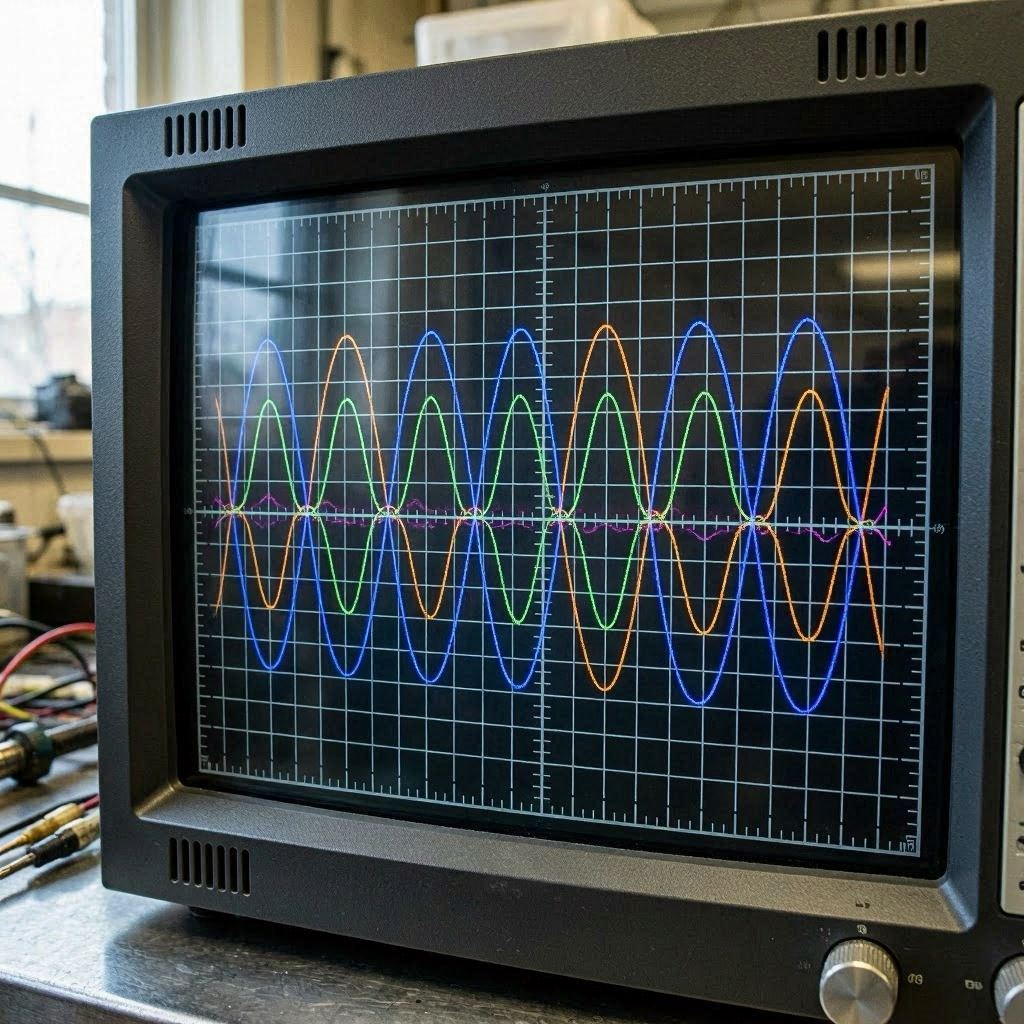
How does DSP relate to new products (NPI)? What is analogue and digital signal processing (DSP) about?
All new electronic products are designed to collect data, process it, and provide some useful function for humanity. This is very complex, and its challenges aren’t difficult to perceive. Any sensor, say a microphone, is collecting Gigabytes of data – think of a continuous time based plot of the output from say a speaker, microphone, screen. A notional product is expected to extract the useful information from that, say a word from a microphone’s sound wave. Fortunately, there exist some very powerful tools for doing just this – these days implemented in easy to software (Fourier transforms, FFTs, etc.)
‘Advanced DSP filtering extracts meaningful data from complex data sets’.
What is a real world example of the use of DSP?
A real example from the EM’s history was the development of an ECG waveform to monitor stress levels in human subjects. The image below shows an ECG waveform for a single heartbeat.
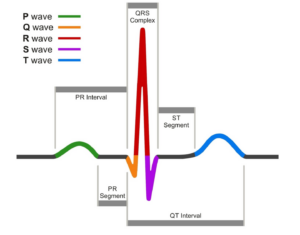
The variation in interval between the R peak of one QRS complex and the one that follows plotted and statistically analysed over time reveals the stress levels of the subject. The task then becomes to get the electronics to detect the exact moment in time for each R peak so that R-R intervals can be calculated. Approximate detection of this is relatively straightforward, but in the presence of electronic noise superimposed on this waveform it becomes complex. It is necessary to remove the noise without affecting the amplitude or phase information in the legitimate ECG waveform. The DSP solution for this was to implement an optimum filter that only lets pass the frequency components present in the ECG waveform (PQRST) and rejects all others.
This was achieved.
How do AI and DSP interact?
As alluded to in the section above, a process such as this requires a lot of data from waveform samples and some fairly complex calculations on the same. In the pre-AI world, this would have been done with a view finding relatively binary answers – RR measurement made, subject stressed or not stressed. AI, particularly edge AI, brings in local factors. Supposing such a device was being used in an old people’s home where heart arrythmia was not uncommon. The actual products used in this scenario could learn via AI to ignore the arrythmia and still make the calculations. AI could change the characteristics of the DSP filter to suit individual humans.
This has barely touched on the AI topic – the possibilities are endless. If you wish to know more about NPI and edge AI, follow the link and read other articles on this site.
What is needed to implement a DSP or DSP/AI project?
To turn a project from and idea to hardware the following development stages must be undertaken:
- Modelling: DSP, like AI, requires modelling. This is mathematical modelling and complex. It will not be covered here, but this shouldn’t put the reader off because the last couple of decades have seen the advent of very powerful software to take the pain out of this – the mathematics that is. What can’t have the pain taken out of it is the definition of the requirement, which must rigorous. The EM has been through this with many projects. Please follow one of the Contact Us links if you require assistance with this.
- Synthesis: having arrived at a definition of the system, it is necessary to implement this in hardware and firmware as an embedded system – assuming embedded edge implementation. This is an arcane process, but it is predictable and straightforward as long as testing doesn’t reveal a model in the previous bullet that isn’t robust.
- Test: it is obvious that a product development using the foregoing principles must be tested. In the pre-AI days this was important, but it is even more so with AI. AI effectively introduces a greatly increased potential modes of operation and corresponding test requirement. There are numerous international standards evolving to try and cope with this, EMC being a typical case, but a neatly packaged answer has yet to evolve. Alert product development companies have their ears to the ground listening for information on this subject.
Should you wish to know more or want to comment on this article please don’t hesitate to Contact us.